
How far do you agree with Interpretation 2 about the popularity of the Nazis inside Germany from 1933 - 1939. Explain your answer, using both interpretations, and your knowledge of Germany at this time. 16 marks
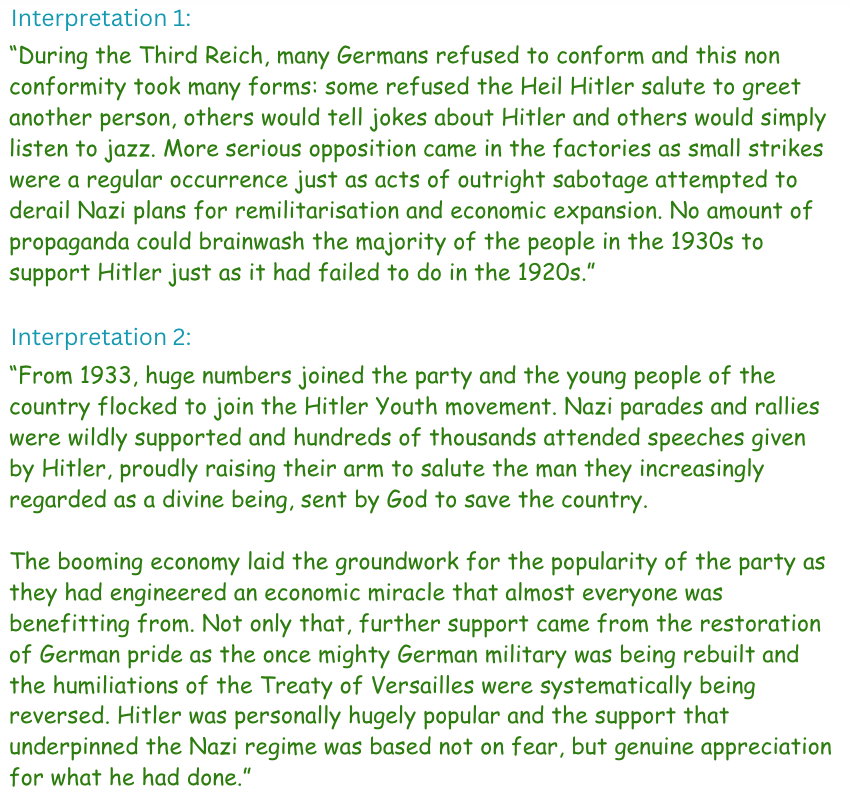
Interpretation 2 is correct to suggest that there was popularity for the Nazis but somewhat overplays its significance. Yes millions did join the Hitler Youth but one must be careful not to assume that joining either the party or any other Nazi led organisation is indicative of the Nazis being very popular. For example the Hitler Youth was formed in 1926 and yet by January 1933 when the Nazis came to power, out of a total available population of boys and girls of about 9 million aged between 10 and 18, the total membership stood at just 100,000 for boys and about 15,000 for girls (in 1932). The fact it was so low indicates that the appeal of Nazism was not that high for young people. If they were so popular amongst Germany’s youth, why, by early 1933, had relatively few actually joined?
However the counter argument is what happened next. By the end of 1933 that number had grown to 2 million. This cannot soley be explained by parents wanting their children to join to be seen as good Nazis, though undoubtedly that was a factor. Much more likely is that nearly 2 million genuinely wanted to join. As former Hitler Youth member Henry Metelmann recalled, having seen the rallies organised by the Hitler Youth and the SA, he was spellbound by the marches, the uniforms and the sense of Germany being on the rise again. He joined because he wanted to be part of it.
By the end of 1937 that figure had jumped to 5.4 million. Superficially it could be argued that this showed how popular the Nazis were. Undoubtedly there is an element of truth in that as previously many young people would simply not have known much about them but now they were in power and restoring lost German prestige, it is reasonable to argue many, but not all, would have enthusiastically joined. A more realistic intepretation of why so many joined the Hitler Youth after 1933 was a combination of two factors. Firstly that they were forced to as it became official government policy in 1936 and reaffirmed again in 1939 and secondly that all other non Nazi youth groups such as those run by the Church were shut down leaving the young people of Germany with little choice but to join the Hitler Youth if they wanted to participate in organised activities with their friends. The very fact that the government had to force people to join the Hitler Youth in 1936 indicates that the idea of joining was not especially popular amongst those who were yet to sign up. In addition the wording of that 1936 decree was somewhat vague and allowed people to interpret that they did not have to join. This is why it was rewritten and reaffirmed again in 1939 so people understood children had to join.
But interpretaton 2 overlooks the fact that they had to compel people to join and then after the first instruction, they had to repeat that demand again in 1939, all of which indicates that there were many who were reluctant to join and thus compulsion was the only option. In addition, SD reports in the later 1930s indicate widespread disillusionment and boardom amongst members of the Hitler Youth (both boys and girls) at the relentless emphasis on physical fitness, marching and ideological indoctrination. The communist inspired Leipzig Meuten, the rebellious Edelweiss Pirates who happily attacked Nazi Youth members and the Swing Youth who refused to adhere to Nazi norms of behaviour by dancing to jazz, are further indications that the Nazis lacked widespread appeal amongst the young.
Interpretation 2 also overplays the importance of the Nazi’s self proclaimed economic miracle as an explanation of Nazi popularity. So in contrast to interpretation 2, interpretaton 1 is correct to highlight the considerable antipathy or plain opposition to the harsh economic conditions imposed on workers by the Nazis. Unemployment had fallen dramatically and many who had been unemployed in 1932 were now being paid a wage and would undoubtedly have viewed the Nazis positively for engineering that improvement but the Nazis obviously massaged the figures. Jews were not counted, those forced to sign up for the Reich Labour Service were not counted, those conscripted into the military were also not counted meaning many were effectively still unemployed and often forced into a situation they did not want to be in. In addition, SD reports indicate considerable opposition to the Nazis in many factories particularly in the later 1930s as the regime’s demands grew louder for more and more military and industrial output. Demands by the Nazis for longer working hours, pay cuts and the general unavailability of many consumer goods as the military was prioritised, meant that many workers would trigger unofficial strikes, would deliberately work slow, turn up late, take sick days or would sabotage production by damaging equipment.
Interpretation 2's claim that ‘everyone benefitted’ is thus questionable given wages for industrial workers did not return to their 1928 levels again until 1941, and even then it was because the workers ‘agreed’ to work extra hours (if you didn’t agree to work overtime, you could be punished by up to a year in prison). In some areas of the economy wages changed little, particularly in agriculture (2% increase 1933 - 1937) and those in the clothing industry saw salaries actually fall 5% in the same period. Not only that, but heavy restrictions were placed on freedom of movement meaning that workers were no longer free to leave one employer and go and work somewhere else and often they were moved to a different employer if their skills were needed elsewhere. Needless tosay, the worker had little choice but to go precisely where they were told. It is easy to forget at the last free and fair election held in Germany in November 1932, the combined vote for the parties of the left, the SPD and the KPD, actually received 4% more votes than the Nazis whose support had dropped from the prevous election in July. Though banned from mid 1933 onwards, the SPD and KPD had a clear basis of support amongst workers and left wing propaganda smuggled into Germany continued to influence them as they were encouraged to rebel as much as possible against a party only a minority had ever voted for. Given that only 80% of the electorate chose to vote in the November 1932 general election (for which the Nazis received 33% of the vote) it is reasonable to conclude that about 1 in 4 people actively supported them as they came to power.
However interpretation 2 is correct to point out that the basis of some of the Nazi’s popularity sprang from the sense of prestige that had returned to the country. Whilst the improving economic climate was a factor in that, just as important was the way Hitler had systematically avenged the Treaty of Versailles, a source of humiliation for almost all Germans. The expansion of the military, the reclamation of lost territory such as the Saar region, the Sudeten Germans returning to German control and the union with Austria all helped to restore battered German pride and the hundreds of thousands who attended Nazis rallies across Germany is indicative that they continued to enjoy at least a clear minority of support in the country. In addition, interpretation 2's argument that fear played little role in the basis of Nazi support in the early years of the regime is confirmed by research conducted on Germans in the 1990s who lived through the Nazi period. The research demonstrated that few ever felt fear and whilst the lack of overt opposition doesn’t necessarily mean that the regime was hugely popular, those studies from the 1990s do at least suggest that most were either supportive or indifferent with occassional pockets of obvious opposition and interpretation 1 details what those pockets of resistance sprang from.
Thus in conclusion it is fair to say that whilst some groups actively supported and even ideolised what the Nazis stood for, the ‘people’s community’ or Volksgemeinschaft that was at the core of Nazi propaganda never entirely managed to be made a reality despite the Nazis best efforts. The fact that Nazi ideology made no serious effort to return after the war ended suggests there was a wider indifference that had laid dormant within the majority of the population during the Hitler years.
