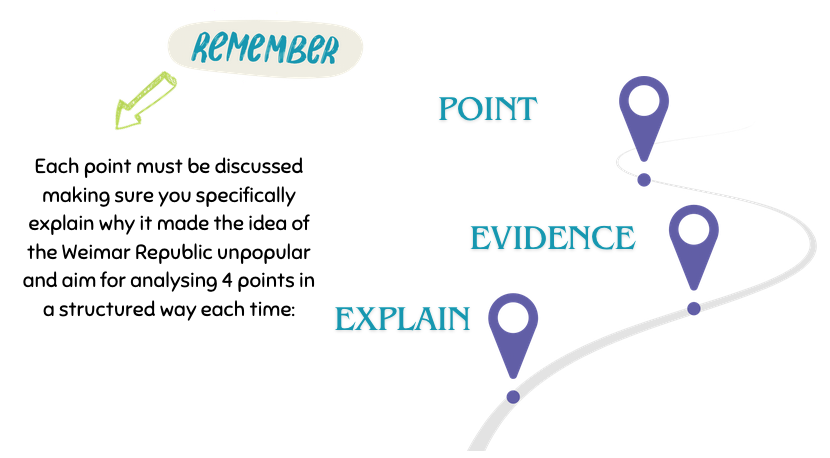
Explain why the Weimar Republic was unpopular in the years 1919-23. Ensure you make reference to the Treaty of Versailles and the new constitution.
It is not strictly correct to say the Weimar Republic was unpopular between 1919 and 1923. In the very first elections held in January 1919 the first government of the Weimar Republic was a coalition of 3 parties: the SPD, the DDP and the Centre party. Between them they got 76% of the votes and all 3 parties were openly supportive of the new constitution that underpinned Weimar Germany.
Nevertheless there was a significant minority who disliked this new Germany, typically associated with the extreme right and extreme left of the political spectrum. One factor that particularly upset those on the right, such as the DNVP and the emerging extreme right wing parties like the Nazis, was the Treaty of Versailles. Specifically the humiliation of the loss of land (Germany lost all its overseas territories and 13% of its land in mainland Europe), the requirements to pay up to £6.6 billion pounds in reparations and the restrictions placed on its military, for example a limit of 100,00 men in the army, no submarines, no airforce, all conspired to create a wave of resentment and since successive new governments had sworn to uphold the terms of the treaty, this reflected badly on them in the eyes of many who hated the humiliation that Versailles had brought to Germany. The hated treaty only made things worse when the French and Belgians occupied the Ruhr region as punishment for Germany refusing to pay any more reparations. Hitler and other leading right wingers would not forget this national humiliation.
The new constitution was also a source of discontent. Those on the right and left disliked the idea of democracy though for different reasons. Conservatives disliked the idea that all adults, regardless of sex or social status were now allowed to vote potentially undermining their previously dominant position in society. Communists disliked democracy as they felt it was a sham, merely a way to reinforce the oppression of the working class by the wealthy. Secondly the constitution had decreed the voting system system should be based on proportional representation but the issue with proportional representation is that it tends to encourage the creation of coaliton governments as no one party can form a majority. Coalition governments are very unstable in times of crisis which was very much the case in the early years of the Weimar Republic meaning that the government would regularly collapse, forcing either another election and the formation of another government. A change of government every 9 months undermined people’s support for Weimar Germany in its early years.
However there were other issues of equal importance that explain some of the discontent inside Germany. The economy was doing poorly. Unemployment was high in 1919, as troops returned without a job to go to, though this did lessen in 1920-1922, only to worsen again with the hyperinflation of 1923. Inflation, the constant rise in prices, was a severe problem making all but the most basic necesities unaffordable for many, whilst also wiping out the savings of the middle classes. From late 1923, hyperinflation would decimate the economy and anyone with life savings.
Housing was in desperately short supply meaning people lived in cramped, overcrowded flats or returning soldiers were forced to live with their parents. Article 155 of the Weimar constitution had promised suitable housing for all Germans but the inability of the government to either encourage private builders to construct more properties or the government themselves to step in and build sufficient amounts of low cost apartments was a major source of discontent towards successive governements as each had failed to live up to the promises made in 1919.
Finally the violence on the streets as pitch battles were fought between communists and Freikorps or right wing radicals as well as the repeated attempts to overthrow the Republic such as the Sparticist uprising of 1919 or the Kapp Putsch of 1920 reflected poorly on the governments of the time. Their inability to maintain basic law and order undermined people’s faith that the structure of government which Weimar had created would ever be able to work.
Tutor commentary:
You must discuss how these two points made all the governments of the new Republic unpopular, but you must also list other reasons why it was unpopular, such as:
- the humiliation of the Ruhr invasion in January 1923
- the instability of successive governments as they collapsed on an almost annual basis
- the inability of successive governments to maintain control of political extremists and prevent regular violent uprisings
- politicians who later created the Weimar Republic were blamed for betraying the army and ending the war - the so called ‘stab in the back myth’.