Explain how propaganda helped the Nazis to control the attitudes of the German people between 1933–1939.
Example Text
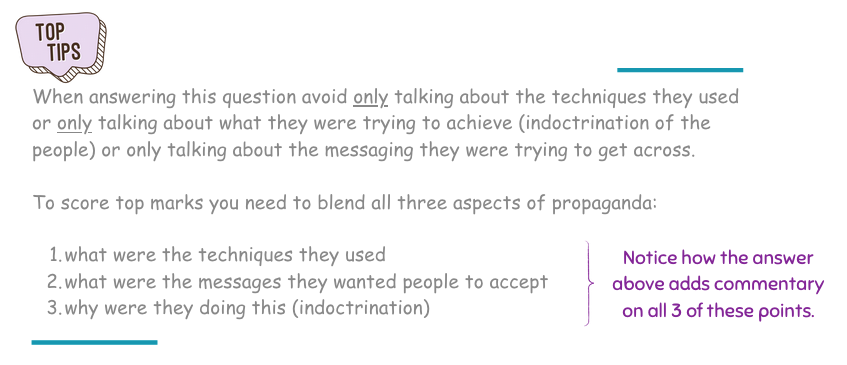
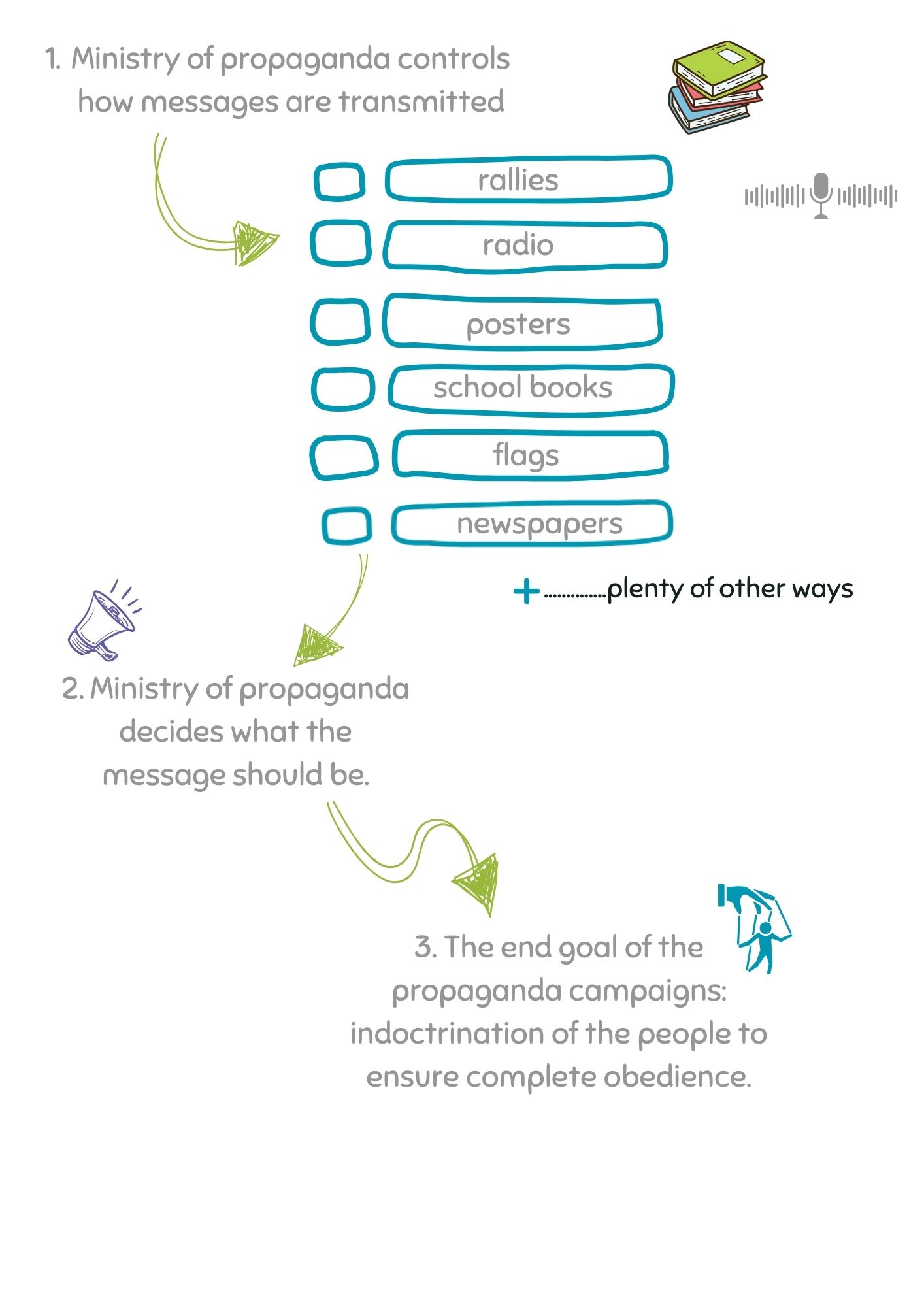
Propaganda was a key method the Nazis deployed to keep control of the German people. This is because it was used to indoctrinate people, particularly Germany’s young children and teenagers. The more indoctrinated the people became, the more obedient they were. Hitler understood that by brainwashing people into believing a number of simple messages, repeated over and over again, he would create a population so compliant (i.e. brainwashed) that no matter how appalling the actions of the Nazis were and no matter how poor the situation might become, the vast majority of the people would continue to blindly follow their Fuhrer without ever questioning the validity of the claims the Nazis, through their propaganda, were making.
The Nazis used a variety of different messages ranging from identifying enemies within: the evil of the Jews and Bolsheviks. Whilst other propaganda sought to define the role of women as mothers to encourage them to stay and home and raise children, or to portray Germany as now entirely united, working solely towards a common goal of a resurgent, reborn country via a people’s community - the volksgemeinschaft. But a theme that was common from almost the moment the Nazis began large scale propaganda was the creation of the cult of personality. The message that Hitler was an almost divine figure, sent down to earth to save Germany, was relentlessly pushed into the brains of every German citizen on a daily basis. So complete was Goebbels’s propaganda machine that it was virtually impossible for people to escape these messages and he fully understood that the more people were exposed to them, the more they would begin to accept them.
An important weapon was therefore their total control of newspapers. The Nazis ensured that the editor of a newspaper was a member of the party, virtually guaranteeing the Nazis were portrayed in a favourable light. No editor would dare to contradict any of the message guidelines that were given to them by Goebbels and it was often the case that he would simply instruct them how they should portray a particular event or idea. The so called Editors Law of October 1933 effectively ended the freedom of the press, thus allowing the Nazis the ability to get whatever message they wanted to get across in print to millions of German homes. To ensure almost complete dominance of the news agenda they went even further by creating several of their own newspapers such as Völkischer Beobachter or those owned by leading Nazis such as Der Sturmer a violently anti-semitic paper that was a mouthpiece of Nazi racial abuse of Germany’s Jewish community.
Another important method the Nazis used to install these messages in people’s minds was the radio. So important did the Nazis view the radio that Goebbels had built a volksemfanger or people’s radio - a low cost radio that even the poorest could afford. 7 million were sold all but guaranteeing that Nazi messaging could be transported directly into every home in Germany. As this was an audio device it was primarly used as a vehicle for the people to hear Hitler’s speeches and even if the people didn’t hear it at home, radios were installed in factories, shops and high streets broadcasting the Fuhrer’s words whenever he made a speech. The advantage of the radio compared to other forms of propaganda is that it does not require someone to be actively absorbing it. You could literally be going about your daily commute or shopping and here a speech by Hitler or Goebbels meaning that over time, if repeated often enough, the messaging would begin to seep into your subconscious.
But even if you were able to avoid listening to a speech by Hitler, you could not escape Nazi propaganda elsewhere as posters denouning the Jews or promoting Hitler’s genius were everywhere. Vast rallies were used to reinforce Nazi messaging about a resurgent Germany with Hitler often appearing from within the crowd portrayed as an ordinary man imbued with extraordinary, God given powers. The immense size of the rallies designed solely to reinforce the idea to people attending or watching at the cinema, that vast numbers were prepared to come and listen to him speak.
It should also be noted that Goebbels himself felt that propaganda was most effective when it was most subtle. Posters were one thing, but they were often very direct and required little analysis as to what the messaging was. That’s why Goebbels also put a lot of effort into less obvious forms of propaganda such as the promotion of Nazi approved art to glorify the country’s history, changing the school curriculum to promote Nazi racial theory, the use of flags everywhere to ensure people understood the country was under total Nazi control.
Whatever your course is, we have a model answers book for you: